Table of Contents
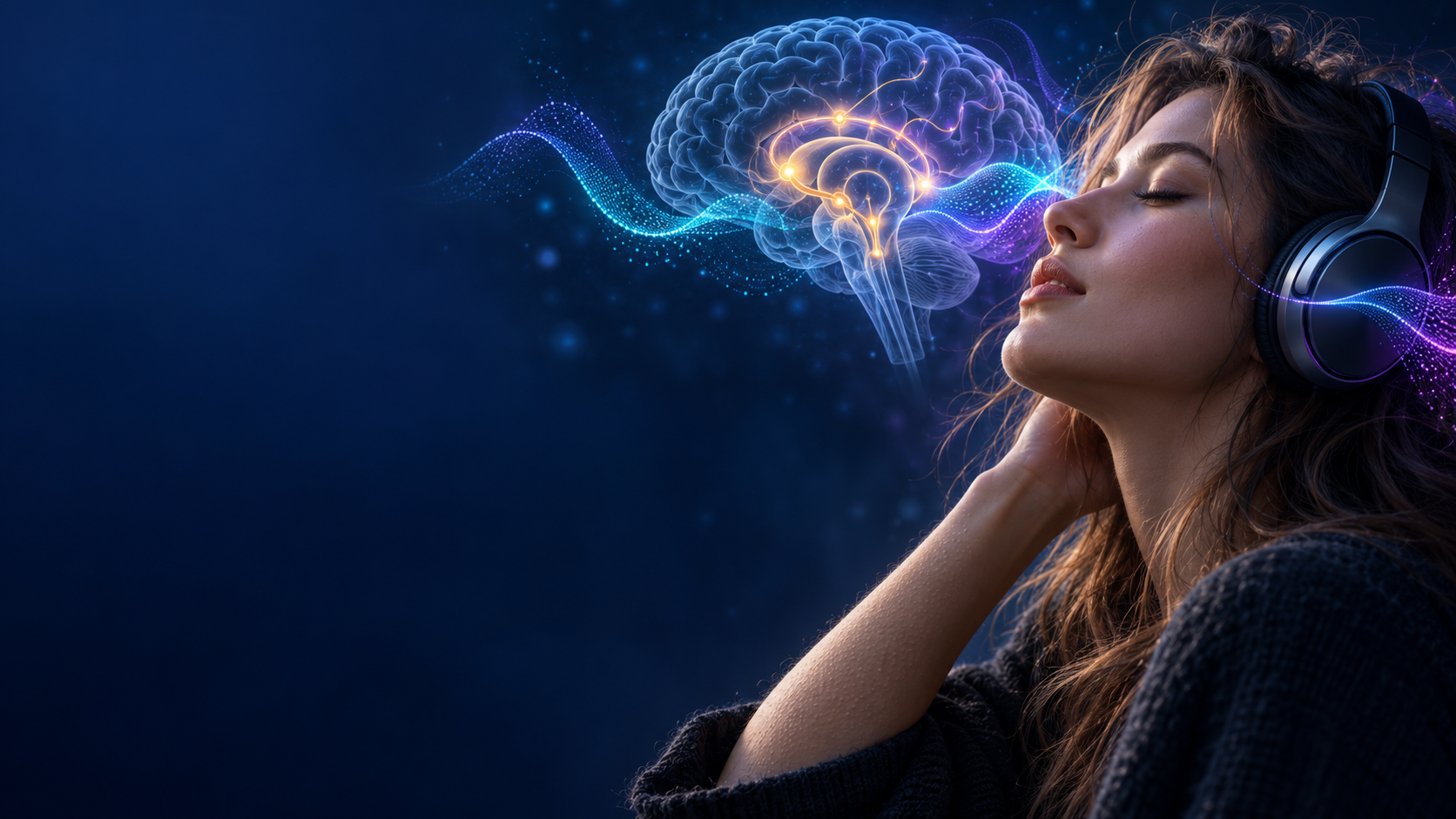
A song reaches its chorus, the harmony changes and suddenly a wave runs across your skin. Why music gives you chills has a scientific explanation involving prediction, emotion, memory and the brain’s reward system.
Your heart may beat faster. Your breathing may change. The hair on your arms rises, even though the room is not cold.
This experience is often called music-induced chills, or frisson. It may feel mysterious, but it reflects a real interaction between sound, expectation, emotion and the body.
Why Music Gives You Chills: What Are Music-Induced Chills?
Music-induced chills are brief moments of intense emotional arousal that can occur while listening to music. They may include goosebumps, tingling, a shiver down the spine, a lump in the throat or a sudden feeling of emotional intensity.
Although goosebumps are commonly associated with cold temperatures or fear, music can trigger a similar physical response without an obvious environmental threat.
The reaction does not come from sound alone. It depends on how the brain interprets patterns, predicts what may happen next and responds when the music confirms—or creatively violates—those expectations.
Why Music Gives You Chills Starts With Prediction
When you listen to a song, your brain does not passively receive a sequence of sounds. It tracks rhythm, melody, harmony, repetition and timing.
Even when you have never heard a particular song, years of listening have taught your brain what certain musical patterns usually do.
You begin to expect the beat to return. You anticipate the chorus. You sense that a chord is about to resolve.
Musicians can create emotional tension by delaying the event you expect. They may pause before the chorus, introduce an unexpected harmony, bring in a new voice or suddenly shift the volume.
When the anticipated moment finally arrives, the combination of tension and resolution can feel unusually powerful.
Anticipation Is Part of the Reward
One important clue to why music gives you chills is that pleasure can begin before the most powerful musical moment arrives.
In a neuroimaging study of listeners experiencing strong pleasure from music, researchers found evidence of dopamine release in the striatum. The study also identified different patterns during anticipation and during the peak emotional moment: the caudate was more involved before the peak, while the nucleus accumbens was more involved during it.
This does not mean that every enjoyable song creates the same response in every brain. It shows that, under the study’s conditions, intensely pleasurable musical experiences engaged systems involved in reward and motivation.
The build-up matters. Part of the pleasure may come from knowing that something is approaching without knowing precisely how it will arrive.
That helps explain why the few seconds before a favorite chorus can sometimes feel nearly as powerful as the chorus itself.
Why Does the Body React?
Understanding why music gives you chills also requires looking beyond the brain because strong emotions can produce visible physical reactions.
Emotion is not restricted to thoughts inside the head. The brain communicates with systems that regulate heart rate, breathing, sweating and other bodily responses.
During a powerful musical moment, emotional arousal may therefore become physical. A listener might notice a faster heartbeat, a deeper breath, tears or goosebumps.
The feeling can resemble a response to danger, but context changes its meaning. You are usually safe, and the arousal is being produced by an emotionally significant pattern of sound.
In this setting, the body’s reaction may be experienced as pleasurable rather than threatening.
Why Do Certain Moments Trigger Chills?
There is no single musical formula that guarantees chills. Common triggers may include:
- A sudden entrance by a powerful voice
- An unexpected harmony or chord change
- A dramatic change in volume
- A pause followed by a strong return
- Several voices joining together
- A melody connected to a personal memory
- The moment musical tension finally resolves
One listener may react to a quiet vocal crack, while another responds to a huge orchestral crescendo.
The same person may also react differently on different days. Attention, mood, surroundings and personal associations can all influence the experience.
Familiarity and Surprise Can Work Together
A familiar song gives the brain a detailed map of what is coming. This allows anticipation to begin before a favorite moment arrives.
However, music that is completely predictable can lose some of its emotional force. Surprise introduces uncertainty, while familiarity supplies structure.
Many powerful musical moments appear to balance both: the listener understands the pattern but still encounters something fresh, delayed or unexpectedly intense.
Research has also connected the reward value assigned to unfamiliar music with interactions between auditory regions and the nucleus accumbens. This suggests that musical pleasure involves communication between systems that analyze sound and systems involved in valuation.
Memory Can Make a Song More Powerful
To understand this connection more clearly, explore how memory shapes emotion and influences the way past experiences are recalled.
Music can become linked with people, places and periods of life.
A song associated with a graduation, relationship, loss or childhood memory carries more than its melody. Hearing it again can reactivate part of that emotional context.
This is why a technically simple song may produce an overwhelming reaction in one listener and almost no reaction in another.
The difference is not necessarily musical sophistication. The song may have become a key that unlocks a highly personal network of memories and feelings.
Does Everyone Get Chills From Music?
No. Some people experience music-induced chills frequently, some only occasionally and others may not recognize the experience at all.
That difference should not be treated as a test of intelligence, empathy or emotional depth. People vary in musical preference, attention, memory, physiology and sensitivity to reward.
Absence of goosebumps does not mean absence of enjoyment. Someone may deeply appreciate music without displaying this particular physical response.
How to Notice the Experience
You cannot force chills reliably, but you can create conditions that make an emotional response easier to notice:
- Use good headphones or listen in a quiet room.
- Choose music that feels personally meaningful.
- Give the song your full attention.
- Avoid skipping directly to the “best” moment.
- Let the anticipation develop naturally.
The goal is not to chase a physical reaction. It is to notice how expectation, emotion and the body interact while you listen.
The Bigger Picture
Ultimately, why music gives you chills cannot be explained by one note, instrument or so-called magical frequency.
Music is made from vibrations in the air, yet the experience it creates can involve prediction, memory, movement, emotion and reward.
Those chills are not proof that a song contains a magical frequency. They are evidence of what the listener’s brain and body are doing with the sound.
The next time a song sends a wave across your skin, notice what happened immediately before it.
Was there a pause? A new voice? A memory? A long-awaited chord?
The answer may reveal that your reaction began before the musical peak ever arrived.